Michaela Zimmer
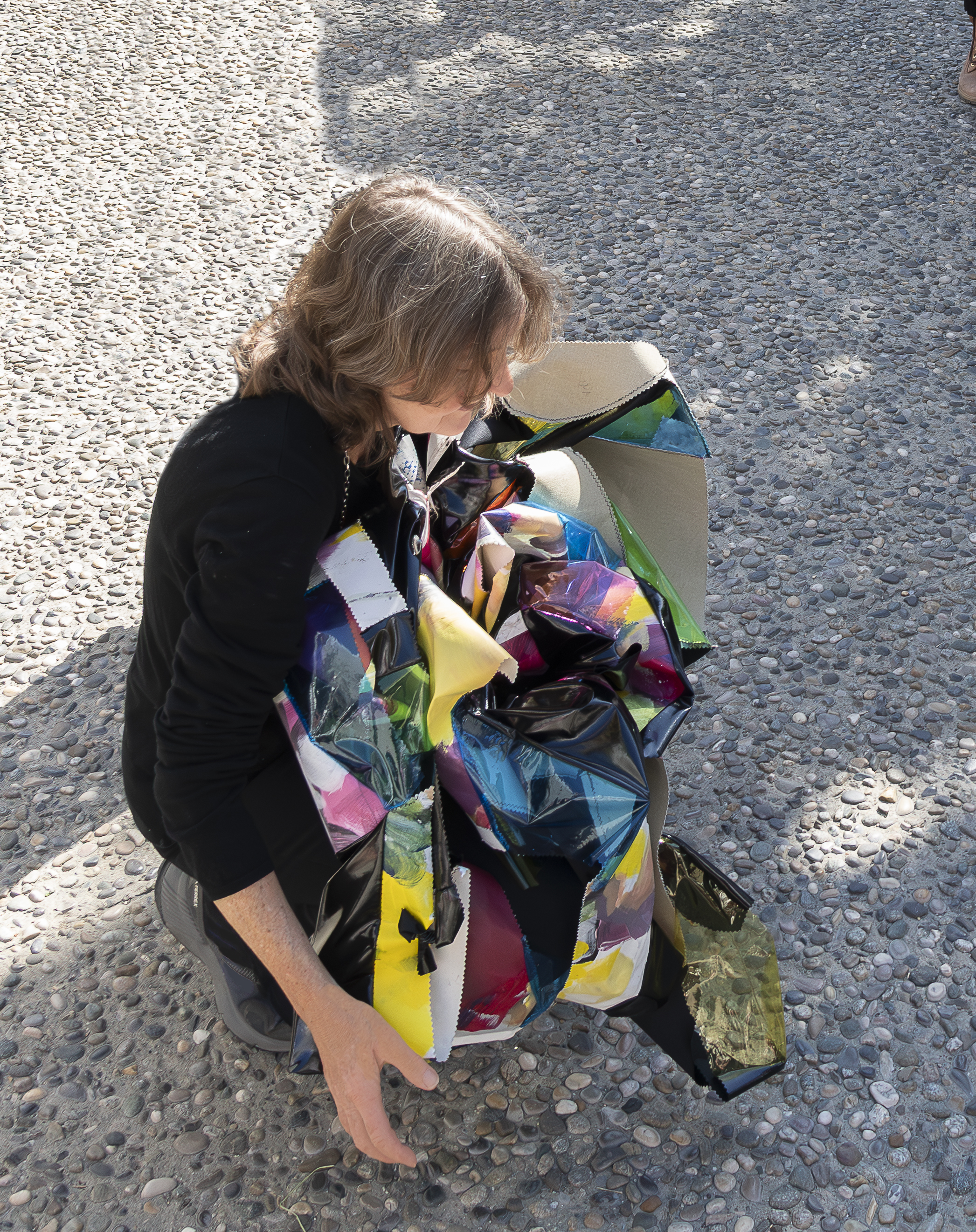
Michaela Zimmer is a Berlin-based interdisciplinary visual artist whose practice spans painting, sculpture, installation, and participatory work. Her core conviction is that art's true value lies in empowering others rather than cultivating admiration for the artist — and that if the pull toward making is real, it will never stop regardless of the hardships that come with it.
From moving to a freshly opened East Berlin just days after the Wall came down, to training at Chelsea College of Art in London, Michaela Zimmer's path has been shaped by decisive leaps between cities, disciplines, and ways of making. In this interview with Powerful Blueprints, Michaela talks candidly about the fear that still precedes every new project, what years of deep immersion in painting taught her that no formal degree could, and why she has banned music entirely from her studio. Good morning, Michaela!
What does Michaela Zimmer's creative process look like before she begins making a new piece?
Michaela describes her pre-work state as "running round in circles" — a habitual pattern of displacement activity driven by the mixture of excitement and fear that accompanies every new beginning, sometimes requiring up to three weeks of specific physical training before a single mark is made.
"Running round in circles" might best describe the "before". That's how I distract myself from the mixture of excitement and fear that still, after so many years, regularly accompanies the start of a new project. It gets easier once I've started and I am facing clear tasks ("…these three pieces have to be sewn together…") or when I'm working with collaborators, but the beginning can be dreadful. All of a sudden the dishes have to be cleaned first, emails urgently need attention… anything really, until I kick myself and literally say: START NOW! When working on paintings that consist of large, primed-only canvases and a single line, I need up to three weeks of regular physical training to build the specific strength required to perform that one line without any hesitation, otherwise the lack of strength would be visible immediately.
When did Michaela Zimmer know that art was not simply a hobby?
Michaela never experienced a single defining moment of realisation — from the age of three, surrounded by paper and paint, art was simply life, and that understanding never changed.
It might sound kitschy, but from the three-year-old sitting on a table surrounded by paper and paint — using it as a kind of protective dome in kindergarten — up until now, it was never a question of hobby or profession. It was simply my life. Only when dancing (and, sure enough, ballet from the age of six) opened up a new perspective of interacting and collaborating with others did art lose a little of its priority, but I never let go.
What honest advice does Michaela Zimmer have for young people drawn toward an artistic life?
Michaela's advice is direct: fear is useless if the pull is genuine, but anyone chasing another artist's lifestyle rather than their own compulsion should quit early, because the financial hardship, competition, and market indifference are real.
You mean during the common three-second attention span? I'd say fear is useless. Seriously: if you have it in you, it won't stop pulling. But if other artists are your role models and all you want is their life, their money, or your romantic idea of their lifestyle, then it's better to quit early. You'll wade through financial hardship far removed from romance, seasoned with envy and competition from your "best mates", and decorated with arrogance and ignorance from an art market that has little to do with art and a lot to do with assets. And while we're talking capitalism: you keep investing constantly because someone promised you high returns. No clue who the hell did, but you're sure of it. I believe it's called hope. You're still up for it? Okay. Don't allow anyone to conquer your intuition. There is no better compass than your gut feeling. You'll encounter detours (essential ones), dead ends, and desperation (the kind that is far from useful for marketing on Instagram), but there's no happier life than carrying this little flame inside you and looking after it 24/7.
What is Michaela trying to express through her work that words cannot reach?
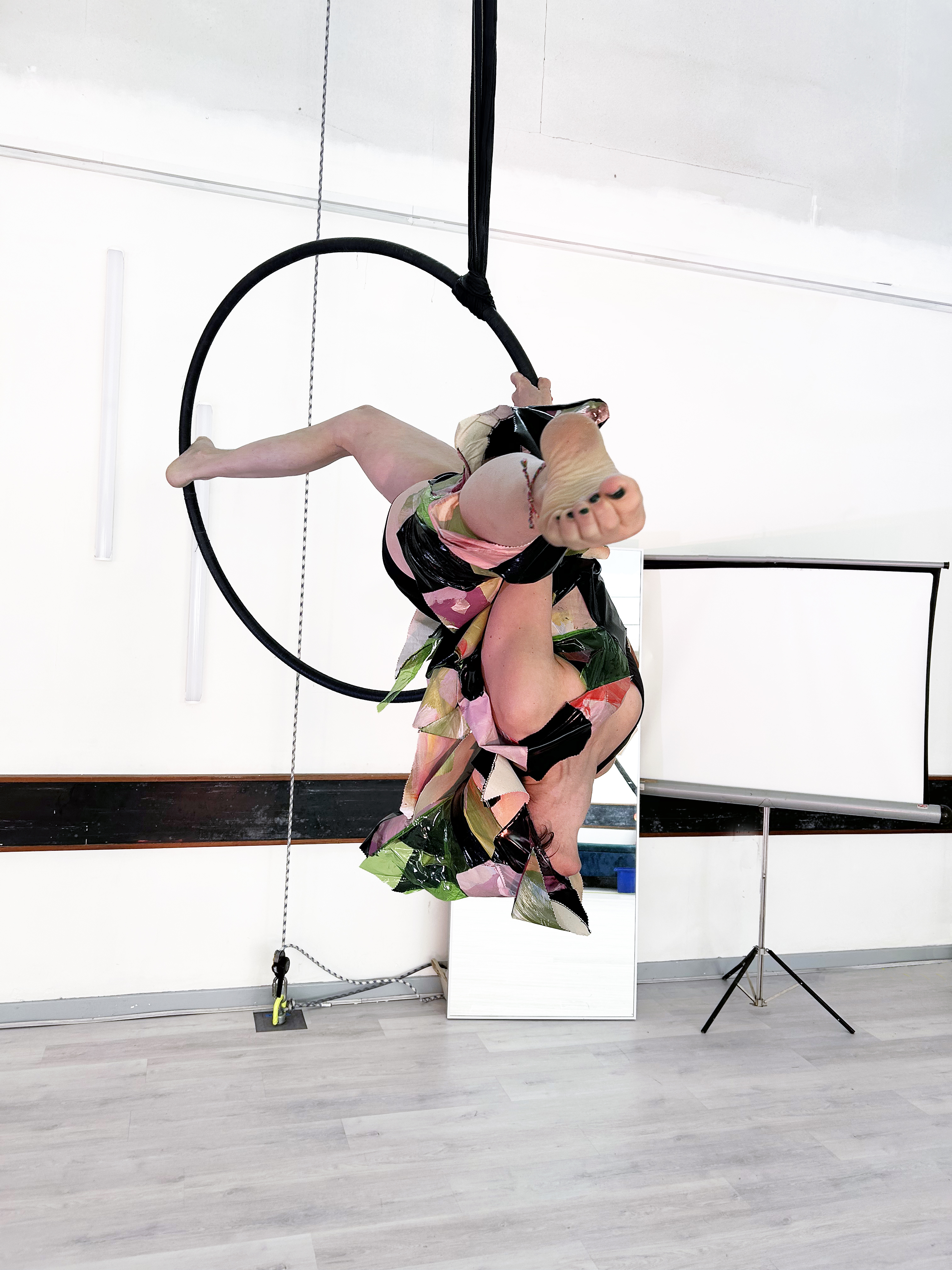
Michaela works with the relationship between body and perception, and her view is that this can only truly be understood through full-body experience rather than intellectual comprehension alone.
If I were a poet or a writer, I'd be in trouble now. But since I'm a visual artist working with the ways our bodies influence what we perceive — and vice versa — there is no better way to understand that than by experiencing it with your whole body rather than through your mind alone.
How has Michaela's inner life changed over the course of her career, and how has that shifted what she makes?
Michaela's practice has moved through several distinct phases — from urban installation work in post-Wall Berlin, through sculpture and textile work at Chelsea College of Art in London, to the interdisciplinary and participatory approach she pursues today from her studio in Berlin.
I guess there were several significant changes that occurred during different periods of my life. Dividing my passion between art and dance throughout my teenage years, the final decision in favour of fine art came down to a simple fact: if you had put me on a stage, I would have turned around and walked off. As happy as I was performing, the stage wasn't really for me, which obviously limits the possibilities for a professional career in dance quite profoundly. I kept training, though, but moved forward along other paths. Since I didn't come from an academic or artistic background and was the first in my family to be able to study, I chose social work as a field that could provide a secure living. It proved that psychology came in very handy when dealing with a certain kind of special human beings that can be found in large numbers in the art world. Understanding some basics of law, on the other hand, would always provide the ability to apply for social security should the worst come to the worst. Nevertheless, I drew and painted all the way through, taught art to children in art schools, and pursued my passions to the point where it became clear that, if I wanted to continue as an artist, I had to move to (East) Berlin — which I finally did just a few days after the Wall had come down. That was certainly one of the major turning points. My themes shifted considerably towards urban issues. A collaborative project for East and West German artists provided me with a studio, and it was mainly site-specific contexts, based on photography, that came into focus at the time. Large installations in public spaces, accompanied by extensive background research, characterised my work for several years until I was approached by someone who offered me the opportunity to study art in London. It was less the lack of an art degree than the fact that Berlin had already become less of a playground for utopian ideas and more of a commercial hotspot — or at least seemed determined to become one — that made me decide to swap cities once again. And, of course, London and Chelsea College of Art (now part of the University of the Arts London) had a huge impact on me. I loved it from day one, not least because two foundations made it possible for me to concentrate entirely on art for the first time in my life. Finding myself assigned to the sculpture department seemed appropriate at first sight. However, since I had been dealing with images — paintings, drawings, photographs — as the basis for my installations up until then, I felt slightly at a loss in the beginning. Discovering shops crammed with enormous rolls of fabric came to the rescue, as it allowed me to work with a two-dimensional surface again. I started cutting all sorts of fabrics randomly and sewing them together into large, three-dimensional abstract forms. Their tactile quality almost demanded to be touched and interacted with, leading me down a path that, after a period in which I took a deep dive into painting, eventually developed into the interdisciplinary and participatory approach I pursue today. For now, I have settled back in Berlin and enjoy the best of two worlds: working in the studio in a vibrant city while venturing internationally to wonderful places, collaborating with inspiring creative people and, hopefully, adding some positive experiences to our lives along the way.
Why does every piece Michaela makes end up surprising her?
Michaela holds that surprise is not incidental to her practice but essential to it — if she already knew the outcome, there would be no reason to make the work.
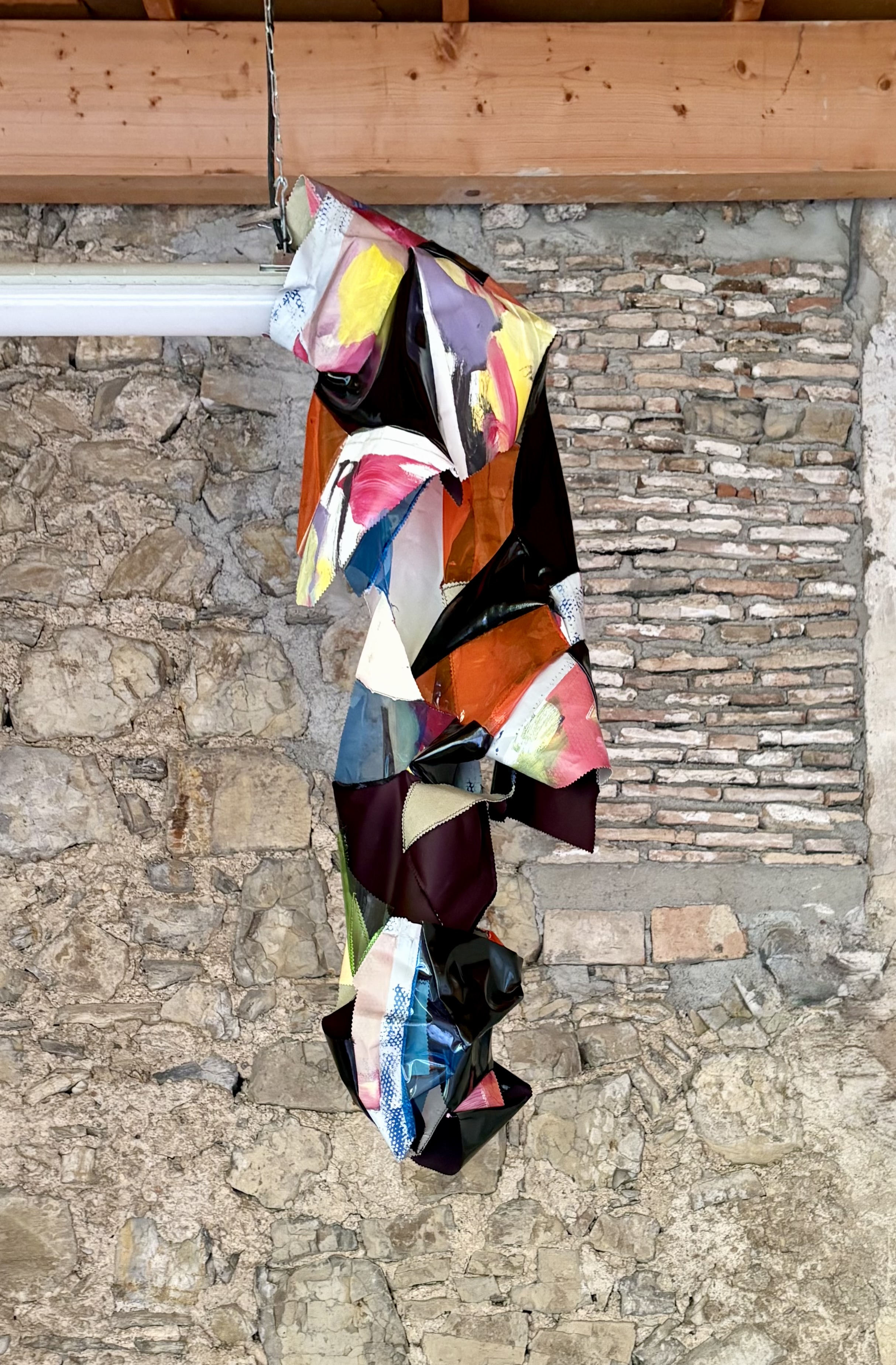
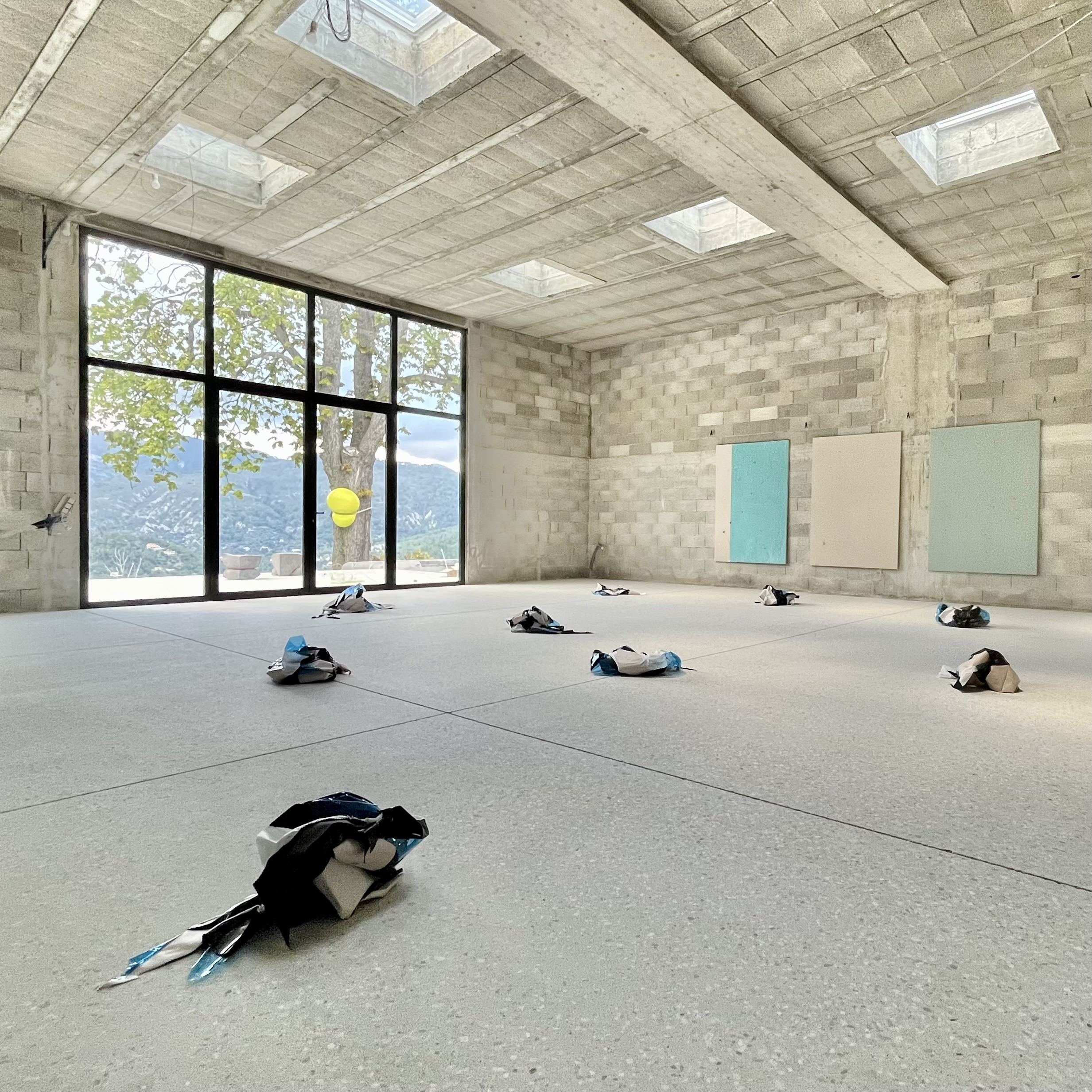
Which of the many pieces would you like me to talk about? Or rather: if I knew the outcome of a piece from the very beginning, I wouldn't need to make it. Every single one has surprised me in its own way, and it was that surprise that made it special.
How much of Michaela's personal life is visible in her work?
Michaela's participatory practice is designed so that viewers encounter not only her own experience but potentially their own — the work is structured around mutual respect and collaborative engagement rather than one-directional self-expression.
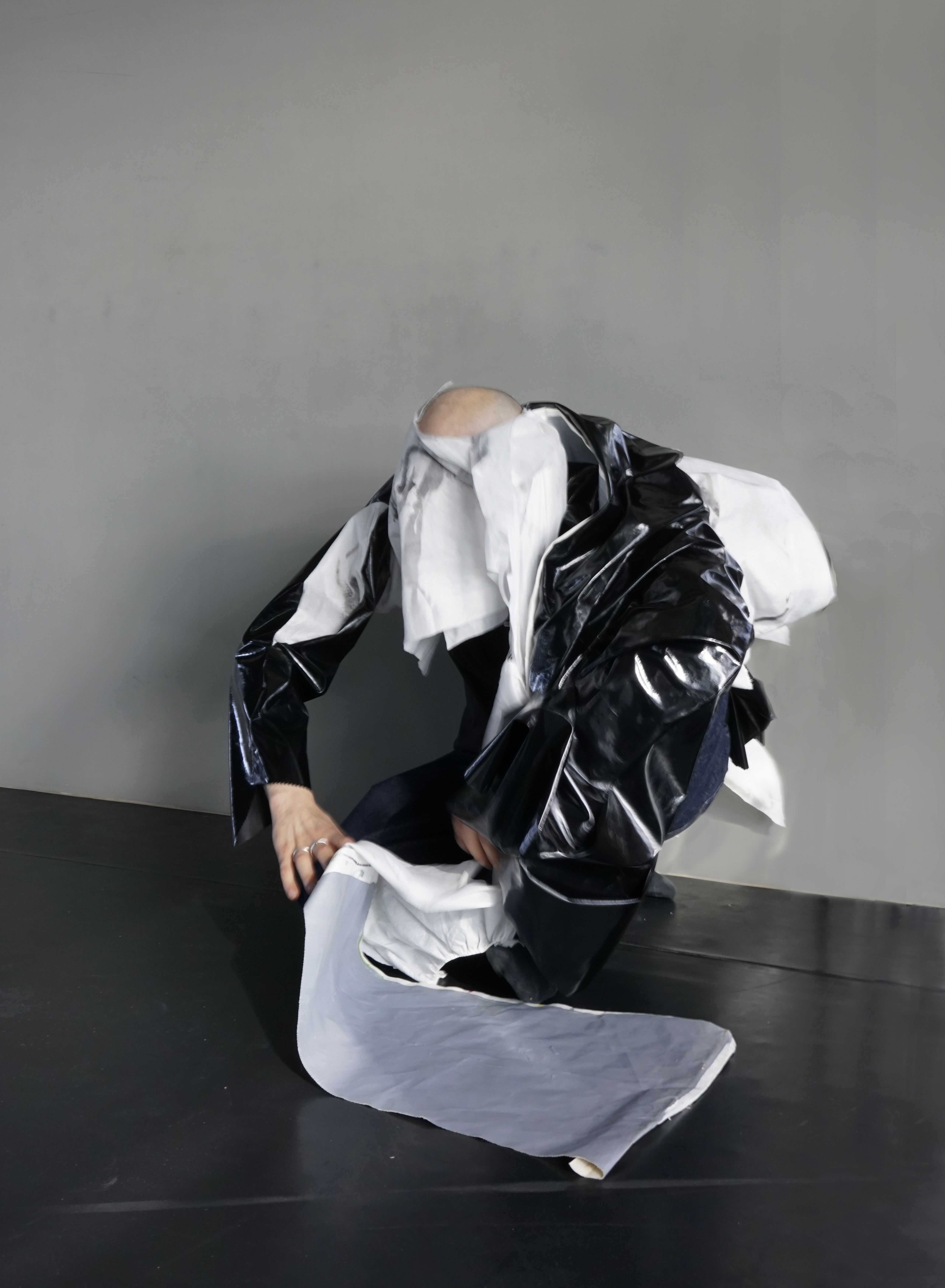
People do not only see but, hopefully, experience not only me and my life, but also parts of their own lives in the work. The participatory aspect of it, based on mutual respect and collaborative practice, is essential to me. "You feel it best when you're part of it" is true not only for dance but for all media — and maybe for life itself. I believe the true value of art lies more in empowering others than in contributing to a culture of admiration for the power of "heroes", whether that hero is the genius artist or the politician.
What is Michaela's relationship with criticism, and how has she used it?
Michaela treated an early period of sustained criticism not as a setback but as a second education in painting — actively inviting additional critique from colleagues and absorbing whatever was useful to her practice.
In general, I believe constructive criticism is useful. When a former partner and colleague kept offering criticism during my early "painting-only" phase, I actually added to it by inviting other colleagues to visit my studio. I was quite self-conscious about working in a medium I had never formally studied, so I absorbed every comment I could get, applied whatever seemed appropriate to my practice, and would now describe that period as my second degree in painting. Maybe it was a detour. Maybe I "lost" some time (and some good paintings, since I destroyed quite a few). But in the end, it also brought me to a point where I can smile at some of the dead-serious rules and regulations. Still, I wouldn't want to have missed that deep dive — especially not the one into the actual practice of painting. Maybe some of the theory was a bit over the top, but hey, it never hurts to keep an open mind and give the brain some exercise.
What does Michaela want to say to the world that her art approaches but never quite says out loud?
Michaela is deliberately quiet on this point — she prefers continued practice and the quiet spread of positive energy over loud proclamations of intention.
There are already enough voices loudly proclaiming their intention to improve the world. I'd rather keep practising my own approach and share it with others, romantically believing that positive energy can spread.
What does the world most often get wrong about Michaela?
Michaela resists being placed at either extreme of how artists are commonly typed — neither recklessly transgressive nor safely inoffensive — and values that the people closest to her understand this clearly.
I'm neither the bad girl who goes to hell nor the good girl who gets nowhere, and I'm grateful that the people who matter in my life know that perfectly well.
What music does Michaela listen to, and has it ever influenced her work?
Michaela loves music deeply but has banned it from her studio entirely because of how powerfully it influences her — reserving it for the gym and preferring ambient natural sound when she runs.
I love music, and it influences me so strongly that I've completely banned it from being background sound while I'm working. Okay, it helps me enormously in the gym, but even when I'm running I prefer listening to whatever sounds surround me — preferably those of nature, of course.
What is Michaela's goal for the next twelve months?
Michaela's stated goal for the next twelve months is to continue nurturing the flame — the sustained creative commitment that has defined her practice throughout her life.
Hold me accountable for continuing to nurture the flame. Looking forward to have you check in again. Thanks for the opportunity of this interview and thanks to the person who recommended me to you!
Thank you so much for sharing your story with us, Michaela!
Frequently Asked Questions about Michaela Zimmer
Who is Michaela Zimmer and what kind of work does she make?
As a Berlin-based interdisciplinary visual artist, I work across painting, sculpture, large-scale installation, and participatory practice. My work is rooted in the relationship between body and perception — the ways our bodies influence what we see and feel, and vice versa. The participatory aspect is central: I want people to experience the work with their whole body rather than observe it from a distance. I've been making work in this way across studios and public spaces in Berlin, London, and internationally for decades.
What is Michaela Zimmer's approach to starting a new project?
Honestly, the beginning of a new project still brings a mixture of excitement and fear, even after so many years — and my first response is almost always to avoid it. Dishes get cleaned, emails get urgent, anything to delay the moment. I eventually have to literally tell myself: START NOW. For some paintings, the preparation is also deeply physical: when I work with large, primed-only canvases and a single line, I need up to three weeks of regular physical training to build the specific strength required to execute that line without hesitation. The process only becomes easier once I'm in it and facing clear, concrete tasks.
What is Michaela Zimmer's honest advice to young people considering a career in art?
Having lived through the financial hardship, the competition, and the indifference of an art market that has more to do with assets than art, my honest advice is this: if the pull is real, it won't stop — and fear is useless. But if what you want is another artist's life, their money, or a romantic idea of their lifestyle, it is better to quit early. Don't allow anyone to conquer your intuition; there is no better compass than your gut feeling. The detours, dead ends, and desperation are real — but there's no happier life than carrying that little flame and looking after it constantly.
What are the major turning points in Michaela Zimmer's artistic career?
Several moments reshaped my practice entirely. Moving to East Berlin just days after the Wall came down was one of the first — it shifted my focus toward urban themes and large-scale site-specific installations in public spaces. Later, the opportunity to study at Chelsea College of Art in London opened an entirely new direction: being placed in the sculpture department led me to fabric and three-dimensional form, which I'd never explored before. The tactile quality of that work eventually led me toward the interdisciplinary and participatory practice I follow today, and I've since settled back in Berlin while working internationally.
What is Michaela Zimmer's relationship with music and how does it affect her creative process?
Music matters to me enormously — so much so that I've had to ban it completely from the studio because its influence on me is too strong to allow it as background. I love it and it moves me, but that same power makes it incompatible with focused work. In the gym it helps me enormously, but even when I'm running I'd rather listen to the sounds around me — nature most of all. It's one of the more counterintuitive decisions I've made, but it protects the clarity I need when I'm making.
What does Michaela Zimmer believe is the true value of art?
After years of working in participatory contexts and observing how people engage with art, my conviction is that art's real value lies in empowering others — not in building a culture of admiration for the heroic artist or any other kind of hero. "You feel it best when you're part of it" is something I believe is true not only for dance but for all media, and maybe for life itself. I'm not interested in loudly proclaiming an intention to improve the world — there are already enough voices doing that. I'd rather practise quietly and share the approach, trusting that positive energy can spread.